Industrial Timing Belt: Key to Precision in High-Performance Machinery!
In the fast-changing world of manufacturing, automation, and industrial engineering, the relentless quest for precision and operational efficiency drives the evolution of every component—down to the smallest detail. When it comes to translating motor power into perfect, synchronized movement, few elements are more critical than the Industrial Timing Belt. These specialized belts quietly enable everything from high-speed conveyor lines to robotics, packaging machines to automated assembly systems, and play a pivotal—though often underappreciated—role in ensuring the seamless functioning of high-performance machinery.

Yet, the decision to choose the optimal Industrial Timing Belt for any application is far from straightforward. With technological advances, diverse belt materials, custom profiles, and integration with Industry 4.0 systems, choosing the right product from countless options has become a strategic decision with far-reaching implications. Machine reliability, uptime, productivity, energy efficiency, and maintenance costs all hinge on this crucial choice
Understanding the Industrial Timing Belt: How Does It Work?
What Is an Industrial Timing Belt?
An Industrial Timing Belt—sometimes called a synchronous or toothed belt—is a continuous belt featuring evenly spaced teeth on its inner surface. These teeth precisely mesh with matched pulleys or sprockets, enabling exact, slip-free transfer of rotary motion and synchronizing multiple mechanical components with pinpoint accuracy.
Why Is Timing So Important?
Timing belts differ from conventional flat or V-belts fundamentally: there’s no slippage between belt and pulley. This makes them irreplaceable in any application where consistent speed, positional accuracy, and repeatable machine cycles are critical. The result is improved machine productivity, product quality, and reduced maintenance compared to older chain or friction-based systems.
Where Are Industrial Timing Belts Used?
The list is extensive, encompassing:
- Automated conveyor and packaging lines
- Robotics and linear actuators
- Printing presses and paper handling
- Textile and weaving machines
- Automated warehouses and sortation systems
- Food processing equipment
- Automotive camshaft and accessory drives
- Precision machine tools
In summary, if your operation demands synchronized movement, the Industrial Timing Belt is likely at the heart of the system.
The Evolution of Industrial Timing Belt Technology
From Chain Drives to Advanced Polymers
In the past, chain and gear systems were the go-to choice for industrial power transmission, offering strong, positive engagement but often demanding regular lubrication, tensioning, and noisy operation. The invention of the industrial timing belt gave engineers a quieter, lighter, and cleaner alternative. Early belts relied on rubber and fabric reinforcements, but advances in material science soon introduced polyurethane, specialized elastomers, and high-strength fibers for even greater longevity and performance.
Today’s Belts: Integration with Industry 4.0
Modern Industrial Timing Belts incorporate smart features—like antistatic coatings, RFID tracking, and easy integration with automated maintenance systems—bringing transmission components in line with the expectations of digital, connected factories.
Shanghai Puteken Transmission System Co., Ltd. is proud to be at the forefront of these innovations, offering belts that satisfy the most demanding precision and durability requirements seen on today’s factory floors.
Why Is the Industrial Timing Belt the Key to Precision?
1. Precise, Synchronous Movement
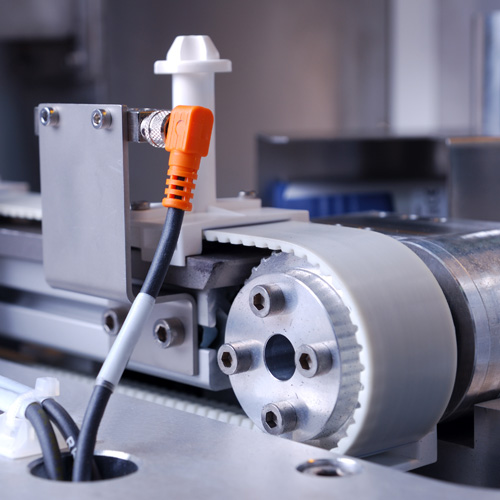
Because the teeth lock directly into matching pulley grooves, the rotational relationship between shafts is exact—no slip, no stretch, no misalignment over thousands of cycles. This translates to:
- Synchronized multi-axis drives
- Accurate product positioning
- Consistent registration for printing or labeling
- Smooth, repeatable performance, even in stop-start duty cycles
2. High Torque Transmission
Modern timing belts are built with strong tensile cords made from glass fiber, steel, or aramid (Kevlar). This allows them to deliver high torque loads while resisting elongation, making them ideal for heavy industrial machinery and fast, repetitive movements.
3. Low Noise and Maintenance
Unlike chains or geared systems, timing belts run almost silently. With self-lubricating properties and no metal-on-metal contact, maintenance requirements are greatly reduced. This means less downtime and lower total cost of ownership.
Also Read: How an Industrial Timing Belt Improves Efficiency in Modern Manufacturing!
4. Energy Efficiency
The reduced frictional losses compared to conventional V-belts or chains translate to real energy savings, supporting both cost and sustainability objectives.
5. Design Flexibility
Timing belts can be manufactured in a wide range of lengths, widths, tooth patterns, and materials. This allows for customization suited to nearly any production need or environmental challenge.
Types of Industrial Timing Belts
1. Classical Rubber Timing Belts
Still common thanks to their cost-effectiveness and broad compatibility, these belts feature a rubber base and polyester or fiberglass reinforcement.
2. Polyurethane Timing Belts
Ideal for chemical, oil, and abrasion resistance. Polyurethane belts, sometimes reinforced with steel, are often selected for longer service life in harsh environments.
3. Open-ended Timing Belts
Supplied in rolls and cut to length, perfect for linear drives, custom conveyors, and indexing systems.
4. Double-sided Timing Belts
Teeth on both sides enable transmission to several pulleys running in opposite directions, common in textile and paper machines.
5. Profiled, Cleated, or Coated Timing Belts
Custom features on the belt’s back can carry products, trigger sensors, or provide gentle handling of fragile goods.
Whatever your application, Shanghai Puteken Transmission System Co., Ltd. offers a full portfolio of industrial timing belts and the expertise to recommend the right solution.
Key Considerations When Selecting an Industrial Timing Belt
Choosing your next belt isn’t just about price. There are multiple parameters to weigh:
1. Application Requirements
- Load and Torque: Match the belt’s strength, width, and cord material to expected loads and maximum acceleration.
- Speed: Higher speeds demand belts with precise tooth profiles and superior wear resistance.
- Environmental Conditions: Consider the presence of oils, greases, chemicals, moisture, dust, and temperature fluctuations.
2. Belt Profile and Pitch
The tooth profile (e.g., trapezoidal, HTD, AT, GT) dictates compatibility with pulleys, noise level, and power transmission efficiency. Pitch (distance between teeth) should suit the required accuracy and force.
3. Material Selection
- Rubber: Versatile, economical, robust.
- Polyurethane: Exceptional resistance to oil, chemicals, abrasives.
- Special Elastomers: For high temperatures, food safety, or static discharge.
4. Belt Construction
- Endless/Molded Belts: Seamless and best for high-speed, high-strength applications.
- Open-ended/Joined Belts: Maximum flexibility for custom conveyors or linear actuators.
5. Pulleys and System Compatibility
Correct pairing with premium pulley materials (steel, aluminum, plastic) and precise manufacturing tolerances maximizes belt lifespan and reduces noise/vibration.
Shanghai Puteken Transmission System Co., Ltd.’s engineering service can analyze your application and guide you to the ideal timing belt system.
Installation and Maintenance Best Practices
Optimal performance isn’t just about having the right belt—it’s about installing and maintaining it properly.
1. Storage and Handling
-Store belts flat and cool, out of direct sunlight or ozone sources to prevent premature aging.
2. Proper Tensioning
-Use tension gauges for accurate installation: too much tension shortens lifespan, too little causes slip or tooth jump.
3. Pulley Alignment
-Check with a straight edge; misalignment accelerates belt and pulley wear.
4. Cleanliness
-Keep belts and pulleys free of dust, grease, and debris.
5. Regular Inspection
-Look for unusual noises, tracking issues, or signs of wear—replace as preventative maintenance before failure.
Industrial Timing Belt Innovations: What’s New?
As demands for productivity and customization grow, so too does belt technology:
1. Smart Timing Belts
-Embedded RFID or sensor systems track wear, load, or thermal cycles—allowing predictive maintenance and minimizing unplanned downtime.
2. Eco-friendly Materials
-Biodegradable materials and solvent-free manufacturing processes reduce environmental footprint.
3. Quick-join Technologies
-Reduced downtime with field-installable splicing kits or mechanical fasteners.
4. Advanced Tooth Designs
-Curved or "HTD"/"AT" tooth profiles for smoother engagement, reduced backlash, and greater load capacity.
5. Integrated Custom Features
-Cleats, coatings, or even magnetic components can be embedded to suit particular handling, detection, or automation needs.
Shanghai Puteken Transmission System Co., Ltd. is committed to keeping customers at the cutting edge by offering the latest solutions and continually investing in belt research and development.
Why Trust Shanghai Puteken With Your Industrial Timing Belt Needs?

- Comprehensive product selection for any application or industry
- Application engineering and technical consulting, from design to after-sales support
- Fast, reliable delivery across Asia and worldwide
- Stringent quality assurance, with ISO certification and traceability
- Commitment to innovation, sustainability, and customer satisfaction
Driving Precision and Performance
The Industrial Timing Belt has evolved into an indispensable force for delivering precision and performance in today’s high-performance machinery. Its ability to provide exact synchronization, reliable power transmission, low maintenance, and robust adaptability makes it the hidden driver behind manufacturing success in every corner of industry.
Frequently Asked Questions (FAQ)
Q1: How long should an Industrial Timing Belt last?
A: Most premium belts last between 10,000–20,000 operating hours, depending on load, speed, and environment. Regular inspection and proper installation are key to maximizing life.
Q2: What is the main cause of Industrial Timing Belt failure?
A: The most common causes are incorrect tension, misaligned pulleys, or using the wrong belt profile or material for the application.
Q3: How do I measure for a replacement Industrial Timing Belt?
A: Measure the belt’s width, total length, tooth profile, and pitch. If possible, refer to original manufacturer specifications or contact Shanghai Puteken for help.
Q4: Can Industrial Timing Belts be repaired?
A: While damaged belts should generally be replaced, open-ended or modular belts can sometimes be locally joined for temporary fixes.
Q5: Are industrial timing belts suitable for food or cleanroom environments?
A: Yes! Polyurethane and specialty rubber belts are available with FDA compliance and low outgassing for hygienic or controlled settings.
Q6: Can timing belts be custom ordered for special applications?
A: Absolutely. Shanghai Puteken offers custom widths, lengths, tooth profiles, coatings, and integrated features to fit any unique requirement.
Q7: Is it worth upgrading from chain drives to Industrial Timing Belts?
A: Yes, in most applications. You’ll benefit from lower noise, no lubrication, increased positioning precision, and reduced maintenance.
Q8: How does belt material affect performance?
A: Rubber offers general versatility, polyurethane gives superior chemical resistance and wear life, while special elastomers handle unique environmental or compliance requirements.
Q9: How frequently should belts be inspected or maintained?
A: Check belts at every routine maintenance interval, at least monthly, and always after a line incident or machine crash.


Comments
Post a Comment